

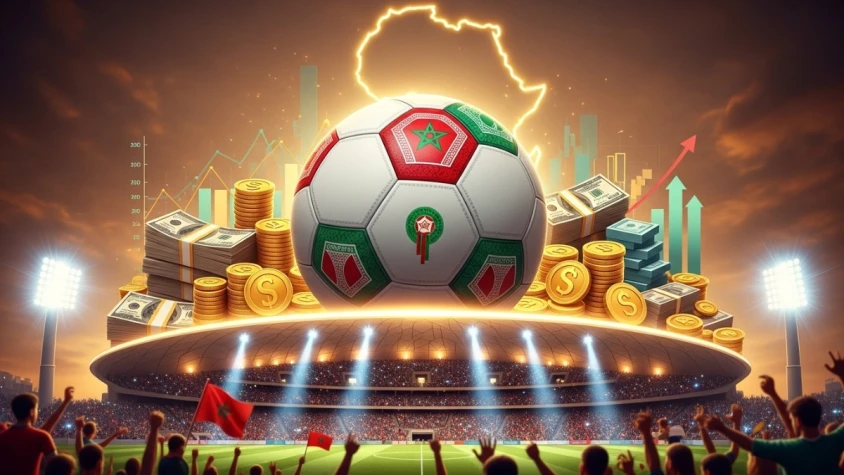
Forget the narratives about passion and continental pride for a moment. The 2025 Africa Cup of Nations in Morocco is quietly becoming the most significant financial event in African football history—and almost nobody is paying attention to what this actually means.
The numbers CAF doesn't want you to overthink
Here's the headline figure: $192.6 million in projected revenue. That's not a typo. That's nearly $200 million flowing into a tournament that, just four years ago, was bleeding money under a financially chaotic CAF administration.
The breakdown tells an even more interesting story:
- $126.2 million from sponsorships alone—two-thirds of total revenue
- $46.5 million from TV and media rights
- $19 million from ticketing and hospitality
With tournament expenses estimated at $78.79 million, CAF is looking at a net profit of approximately $113.8 million. For context, that's more than ten times what CAF reported as its entire net profit for the 2023-2024 fiscal year ($9.48 million).
The Motsepe effect is real—whether you like him or not
When Patrice Motsepe took over CAF's presidency, the organization was a financial disaster. Deficits, operational chaos, sponsors running away. The billionaire mining magnate promised business discipline. Four years later, the numbers suggest he delivered.
The 2023-2024 fiscal year marked CAF's first profitable year in several consecutive periods. Now AFCON 2025 is projected to generate more profit in one tournament than CAF made in total during some previous administrations.
But here's what most coverage misses: this isn't just about better management. It's about timing and geography.
Why Morocco changes everything
Morocco isn't just hosting AFCON—it's auditioning for the 2030 World Cup. Every stadium, every piece of infrastructure, every broadcast arrangement is being built with that bigger prize in mind. That means AFCON 2025 gets world-class facilities essentially subsidized by Morocco's long-term ambitions.
Six host cities. Modern stadiums. A country that has proven it can handle major tournaments. For sponsors and broadcasters, that reduces risk dramatically—and reduced risk means bigger deals.
The prize money tells the real story
CAF announced a total prize pool of $32 million for AFCON 2025. The winner takes home $7 million—a significant jump from the $5 million Ivory Coast received for winning in 2024. A team that goes all the way, collecting bonuses at each stage, can earn up to $11.6 million.
Here's the full breakdown:
- Champion: $7 million
- Runner-up: $4 million
- Semi-finalists: $2.5 million each
- Quarter-finalists: $1.3 million each
- Round of 16: $800,000
- Best third-placed teams: $700,000
- Fourth in group: $500,000
Even the worst-performing team walks away with half a million dollars. For smaller African federations, that's transformative money—enough to fund youth academies, coaching programs, or basic infrastructure that didn't exist before.
The uncomfortable comparison
Let's be honest about what AFCON still isn't. The UEFA European Championship distributed approximately €440 million in prize money for Euro 2024. AFCON's $32 million is barely 7% of that figure.
The gap reflects global football's uncomfortable reality: African football generates less revenue because it attracts less investment, which means less development, which means the talent pipeline flows almost entirely toward Europe rather than building sustainable domestic leagues.
AFCON 2025's financial success doesn't change that structural problem. But it might be the first step toward having enough money to address it.
Where the money actually goes
CAF claims that AFCON revenues fund grassroots development, youth tournaments, coaching education, and infrastructure support across its 54 member nations. Whether that money is distributed effectively—and reaches the federations that need it most—is a separate question entirely.
What's clear is that a $113 million profit creates options that didn't exist before. The question is whether CAF has the governance structures to deploy that capital intelligently, or whether it disappears into the same bureaucratic holes that plagued the organization for decades.
The bottom line
AFCON 2025 represents a genuine inflection point. For the first time, African football's flagship tournament is generating the kind of money that demands serious attention from global sponsors, broadcasters, and—eventually—the clubs that currently treat African leagues as discount talent farms.
Morocco's investment, Motsepe's business discipline, and the growing global appetite for African football have created a moment. What happens next depends on whether CAF can build on this foundation or whether $113 million becomes just another missed opportunity in a long history of them.
The tournament kicks off December 21. The defending champions, Ivory Coast, arrive as favorites. But the real competition might be happening in boardrooms, where African football is finally demanding its seat at the table.