

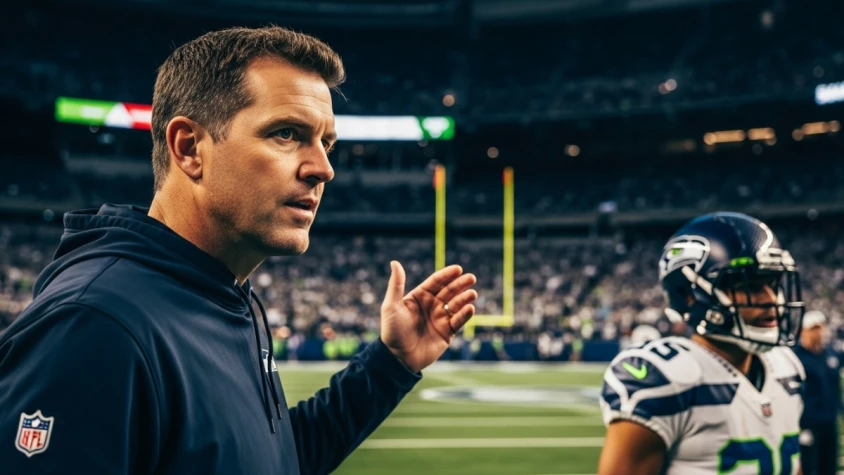
Three days before the biggest game of his career, Seattle Seahawks head coach Mike Macdonald stood at a podium in Santa Clara and talked about tackling.
Not scheme. Not adjustments. Not the chess match against Drake Maye. Tackling.
"We drill the fundamentals of tackling and finishing every day," Macdonald told reporters at his pre-Super Bowl LX press conference. "We do it as a team, we do it in our warmup before games. It's part of our DNA and the guys take a lot of pride in it."
In a league where coaches spend hours dissecting motion packages and disguised coverages, there's something almost refreshing about a guy whose answer to "how do you win a championship?" is basically "we hit people correctly." And yet, when you look at what Seattle's defense did this season — holding opponents to the third-highest rate of two-deep coverage looks on early downs, suffocating the run, generating explosive-play turnovers at a league-best clip — the boring answer kind of checks out.
EAT: the acronym nobody outside the building talks about
Macdonald gave the credit away almost immediately, pointing to outside linebackers coach Chris Partridge as the architect behind Seattle's tackling culture. Partridge has players recite an acronym before every drill: EAT. Effort, Angle, Tackle.
"I have to give just about all the credit to Chris Partridge," Macdonald said.
It sounds like the kind of thing you'd hear at a high school clinic in rural Ohio. That's sort of the point. Partridge, who spent years coaching at Michigan before moving to the NFL, has been obsessed with tackling mechanics since his college days. He runs full-team drills during warmups — not positional breakouts, full-team — which is unusual at this level. Most NFL coordinators consider pregame warmups a time for individual position work and mental reps. Partridge turns it into a group tackling session.
The results speak for themselves. Per ESPN's Bill Barnwell, the Seahawks allowed a 31.5 Total QBR to every quarterback not named Matthew Stafford over the second half of the season and into the postseason. That's not just good — it's borderline absurd. And a huge chunk of that defensive dominance comes from the fact that when Seattle gets to the ball carrier, they finish.
The Macdonald factor
Here's the thing about Macdonald that often gets lost in the Super Bowl hype: he's a 38-year-old defensive coach who was calling plays for the Baltimore Ravens before Seattle hired him. He doesn't come from the Vic Fangio coaching tree, but he shares Fangio's obsession with post-snap confusion — forcing quarterbacks to process after the ball is snapped rather than reading the defense pre-snap.
Seattle plays two-deep safety shells nearly 57% of the time on first and second down. Only the Chargers (run by Jesse Minter, Macdonald's former colleague in Baltimore) were higher. The scheme is built to take away explosive plays and dare the opponent to be patient. Most offenses can't.
But scheme only works when players execute. And execution, for Macdonald, starts with whether your linebacker wraps up the running back on second-and-six. Whether your corner drives the receiver out of bounds instead of diving at his ankles. Whether your safety takes the right angle to the ball.
All the stuff Partridge drills every single day.
What it means for Sunday
New England's offense under Mike Vrabel has been built on Drake Maye's ability to deliver the ball within the normal rhythm of a pass play — 2.5 to 5 seconds after the snap. A league-high 77 of Maye's explosive completions came in that window. He doesn't need to extend plays; he throws with anticipation and trusts his arm.
That's a different challenge for Seattle's defense than what they saw from most opponents this year. The Seahawks can't rely on Maye holding the ball too long or freelancing into coverage. They'll need to get home with their four-man rush — DeMarcus Lawrence has been dominant against the run — and when they don't get a sack, they'll need to make the tackle on the first player who touches the ball.
Which brings us right back to EAT.
The last time these two franchises met in a Super Bowl, it ended with Malcolm Butler's goal-line interception. Eleven years later, it might come down to something even less glamorous: whether Seattle's defenders wrap up clean in the fourth quarter of a game that could go either way.
The Seahawks are 3.5-to-4.5 point favorites. Sam Darnold leads the offense. Jaxon Smith-Njigba led the league in receiving yards. But if Seattle hoists the Lombardi Trophy on Sunday night, don't be surprised if the real reason is the most basic drill in football, run by a position coach most fans have never heard of.
Sometimes the boring answer is the right one.
Super Bowl LX kicks off Sunday, February 8 at 6:30 p.m. ET on NBC from Levi's Stadium in Santa Clara. Sources: NBC Sports (Michael David Smith), ESPN (Bill Barnwell).