

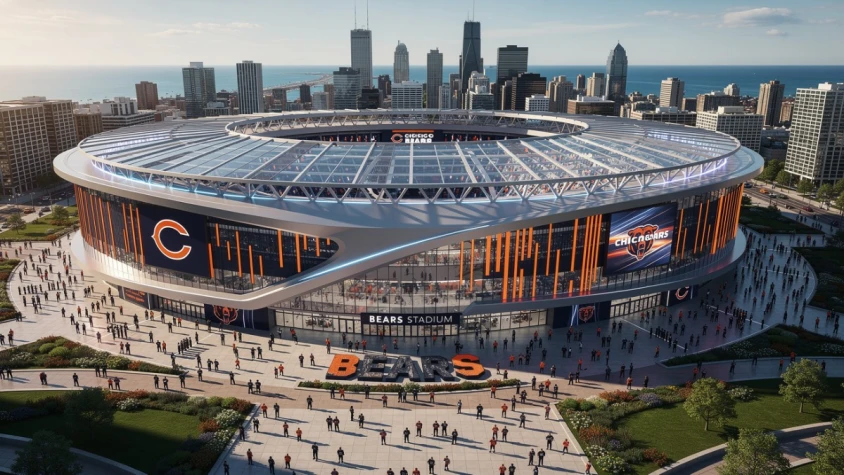
The Bears are serious about leaving Chicago
Kevin Warren just confirmed what everyone suspected: the Chicago Bears' new stadium won't necessarily be in Chicago. The team president released an open letter announcing the franchise is expanding its search beyond Illinois, including Northwest Indiana, for a site to build their proposed 60,000-seat domed stadium. This comes three days before hosting Green Bay in their biggest Soldier Field game in years, and the timing isn't accidental—but the threat is very real.
The Bears want a world-class stadium. They've been chasing this dream since buying the Arlington Park property for $197 million in 2023. What started as a focused vision for a $5 billion mixed-use development has turned into a regional real estate scavenger hunt. Arlington Heights, the Chicago lakefront, back to Arlington Heights, and now potentially Indiana. That's not indecision, that's desperation.
What the Bears actually want to build
The vision is ambitious: a fixed-roof stadium seating 60,000 fans, part of a massive development that would transform wherever it lands. The original Arlington Heights proposal included the stadium as the centerpiece of a $5 billion project with retail, dining, entertainment, and residential spaces. Think of it as a mini-city built around football, similar to what the Rams and Chargers have in Los Angeles with SoFi Stadium.
A domed stadium in Chicago makes sense. Soldier Field's open-air setup is romantic until you're sitting through a December game in sub-zero temperatures. A roof means hosting Super Bowls, Final Fours, concerts, and major events year-round. That's revenue the Bears currently can't access. From a pure business standpoint, the upgrade is overdue.
But building it requires massive infrastructure—roads, utilities, public transit connections, parking. That's where negotiations fall apart. The Bears want to build the stadium with private money but need public funding for everything around it. That's the $855 million question that's sent them shopping across state lines.
Arlington Heights was supposed to be the answer
The Bears already own 326 acres in Arlington Heights, the former site of Arlington International Racecourse. This was the plan. Warren's predecessor Ted Phillips closed the deal in 2023, and it looked like Chicago's NFL team had finally found its home outside the city limits. The location is perfect—close to major highways, plenty of space for development, and far enough from downtown politics.
Then reality hit. Local authorities and the Bears couldn't agree on property taxes, creating a $100 million gap. Suddenly the project was "at risk," according to team statements. That's when the Bears pivoted to exploring a lakefront site south of Soldier Field, promising over $2 billion in private investment. But that deal required similar public infrastructure commitments that politicians wouldn't approve.
So they circled back to Arlington Heights in April during league meetings. Warren said breaking ground before the end of 2025 was the goal. Now, eight months later, we're talking about Indiana. That tells you negotiations in Arlington Heights are either completely stalled or being used as a backup plan.
Why Indiana is suddenly on the table
Northwest Indiana isn't random. It's close enough to Chicago to maintain the fan base, far enough to escape Illinois' political and tax environment, and desperate enough to offer better terms. Cities in Indiana would bend over backwards to land an NFL franchise. The economic prestige alone would be massive for places like Gary or Hammond.
Warren's letter specifically mentions expanding the search "throughout the wider Chicagoland region, including Northwest Indiana." That phrasing matters. He's not threatening to move the team to Indianapolis or some distant market. He's saying the Bears can stay in the greater Chicago area without being in Illinois. Fans could still drive to games. The media market stays the same. It's Chicago's team playing across the state line.
Illinois Governor JB Pritzker called this "a startling slap in the face to all the beloved and loyal fans." He's right. But he also acknowledged the Bears are "ultimately a private business." That's the uncomfortable truth. The Bears don't owe Chicago loyalty if another location offers better terms.
The $855 million infrastructure fight
Warren's letter says the Bears haven't asked for "state taxpayer dollars to build the stadium." Technically accurate. What they want is $855 million in public funding for infrastructure and "reasonable property tax certainty" to secure financing. That's still public money, just labeled differently. Roads, utilities, and site improvements sound less controversial than "stadium funding," but the bill goes to taxpayers either way.
The Bears' argument is that infrastructure investment is standard for projects this size. They're not wrong. Major developments always require public support for the surrounding area. But $855 million is substantial, and Illinois lawmakers are hesitant to commit that much when the state has budget constraints and other needs.
Warren complains about the lack of "legislative partnership," saying the team "listened to state leadership and relied on their direction and guidance." That's corporate speak for "we did what they asked and still got rejected." The impasse is real, and it's why Indiana suddenly looks appealing. A state competing for an NFL team will find the money. Illinois, already hosting the Bears, feels less urgency.
The Soldier Field lease complicates everything
Here's the catch: the Bears are locked into Soldier Field through 2033. That's nine more years. They can't just pack up and leave without massive financial penalties. So all this talk about breaking ground in 2025 is aspirational at best. Even if they start construction tomorrow, they're playing at Soldier Field for years while the new stadium rises.
What this really means is the Bears are setting the stage for the 2030s. By then, the lease expires, and they'll have spent a decade conditioning everyone to accept they might leave. That's long-term strategy, not immediate threat. But exploring Indiana now sends a message: Chicago isn't guaranteed.
What this means for the team right now
Nothing. The 10-4 Bears host Green Bay on Saturday night in a game that could define their playoff path. The stadium situation is background noise. Caleb Williams isn't thinking about property taxes in Arlington Heights. The offensive line doesn't care if the team plays in Illinois or Indiana in 2035. This is business, not football.
But the timing of Warren's letter—three days before the biggest home game in years—is deliberate. The Bears are relevant again. Fans are engaged. That emotional investment creates political pressure. If the Bears leave, someone will be blamed. Warren knows that, and he's using it.
The reality check
The Chicago Bears will get their new stadium eventually. Whether it's in Arlington Heights, along the lakefront, or across the border in Indiana depends on who offers the best deal. This isn't about football tradition or loyalty to the city. It's about maximizing value for a private business that happens to play a sport people care about deeply.
Warren's expansion of the search beyond Illinois is significant. It's not just leverage anymore—they're genuinely exploring alternatives. Indiana is hungry for an NFL team. Illinois is taking the Bears for granted. That gap creates opportunity. The question isn't if the Bears get a new stadium. It's where, and how much Chicago is willing to pay to keep the team that bears its name actually playing within city limits.