

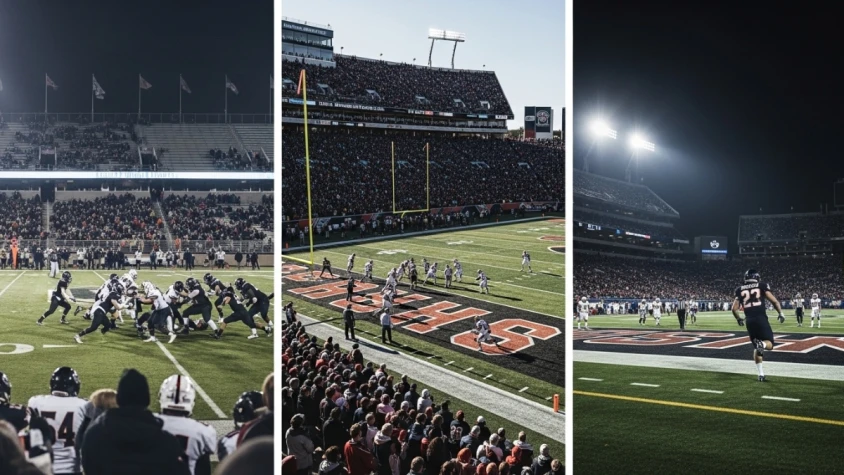
Same game, different universe
Watch a high school game on Friday, a college game on Saturday, and an NFL game on Sunday. The ball's the same shape. The end zones are still 10 yards deep. Touchdowns still count for six. But if you think you're watching the same sport three times, you're missing what actually makes each level unique—and why the transition between them breaks so many players.
The differences aren't just academic. They fundamentally reshape how offenses attack, how defenses scheme, and how much punishment bodies absorb. Understanding these distinctions doesn't just make you smarter at the bar during arguments; it explains why that five-star recruit flamed out in college, and why that college superstar can't figure out the NFL.
The field looks the same. It isn't.
Here's the thing nobody talks about enough: the field dimensions are technically identical at every level—120 yards long, 53⅓ yards wide. Same end zones, same goal lines. But the hash marks tell a completely different story.
In high school, hash marks sit 53 feet, 4 inches apart. That's dividing the field roughly into thirds. In college, they narrow to 40 feet apart. In the NFL, they squeeze down to just 18 feet, 6 inches—aligned directly with the goalposts.
Why does this matter? Because on a high school field, a ball spotted on the left hash leaves the offense with a massive "wide side" to the right. Coaches design entire playbooks around exploiting that space—or hiding from it. College condenses that, and by the time you reach the NFL, the field essentially plays symmetrically from anywhere between the hashes.
Watch an NFL game and notice how often plays develop toward both sidelines equally. That's not an accident. The narrower hashes force offenses to be less predictable and defenses to defend more territory. It's chess from the opening snap.
Clock management: where games are won and lost
The differences in timing rules between levels aren't just technical footnotes—they dramatically alter late-game strategy.
| Rule | High School (NFHS) | College (NCAA) | NFL |
|---|---|---|---|
| Quarter length | 12 minutes | 15 minutes | 15 minutes |
| Clock on first down | Stops until chains set | Stops until chains set | Continues running |
| Two-minute warning | None (except Texas) | None | Yes |
| Play clock | 40/25 seconds | 40/25 seconds | 40/25 seconds |
The first-down clock stoppage is where things get interesting. In college, the clock stops after every first down until officials reset the chains. This gives trailing teams significantly more time to mount comeback drives without burning timeouts. The NFL offers no such luxury—the clock keeps running, which is why you see professional teams in hurry-up mode managing the sideline so aggressively in the final two minutes.
The two-minute warning is an NFL-only phenomenon. It functions as a free timeout for both teams, which sounds minor until you realize entire game plans revolve around reaching that mark with enough time and timeouts to execute.
Catching rules: one foot or two?
This one generates more bar arguments than any other rule difference, and rightfully so.
In college and high school, a receiver needs only one foot inbounds to complete a catch. In the NFL, the requirement jumps to two feet. The implications ripple through everything from route design to cornerback technique.
NFL receivers must plan their footwork on every sideline route, knowing they need both feet down before momentum carries them out of bounds. College receivers can make catches that would be incomplete at the next level. This is why certain possession receivers translate better to the NFL than others—they've already been training for the tighter standard.
It also explains why some college highlight reels look so much more spectacular. Catches that count in the Big Ten become incompletions in the AFC North.
Pass interference: spot foul vs. 15 yards
If there's a single rule that changes deep-ball strategy more than any other, it's pass interference.
In the NFL, defensive pass interference is a spot foul. Interfere with a receiver on a 50-yard bomb, and the offense gets the ball at the spot of the foul. This makes aggressive downfield coverage incredibly risky—one desperate grab can hand the opponent 45 yards.
In college and high school, pass interference is capped at 15 yards regardless of where the foul occurs. Defensive coordinators know this. They coach defenders to be more aggressive on deep routes because the maximum penalty is manageable. If you're going to get beat deep anyway, making contact might be the smarter play.
This single rule difference explains why NFL quarterbacks are more willing to take deep shots into tight coverage. The risk-reward equation is completely different.
Roster sizes: from 150 to 53
The roster ecosystem at each level tells you everything about player development and opportunity.
| Level | Roster size | Gameday active |
|---|---|---|
| High school | Varies by school | No limit |
| College (FBS) | 105 (as of 2025) | No limit |
| NFL | 53 | 48 |
That college number deserves attention. Before the House v. NCAA settlement took effect in July 2025, FBS programs could carry up to 120 players—85 on scholarship plus however many walk-ons they wanted. The new 105-player cap, with unlimited scholarships available, fundamentally reshaped how programs operate.
Nebraska head coach Matt Rhule captured the human cost when discussing the roster changes: "We have some kids on our team that all they want to do is go out and be a Husker. They just want to practice and help the team." Those walk-on dreams are becoming increasingly rare in the scholarship-for-everyone era.
The NFL's 53-man roster (with only 48 active on gameday) means every single player must contribute or face the chopping block. There's no developmental slot to hide in. Practice squads offer a 17-player buffer, but even that lifeline requires daily performance.
Overtime: three completely different approaches
Nothing illustrates the philosophical differences between levels better than how they break ties.
High school uses the "Kansas Plan" overtime, typically starting each possession from the 10-yard line. Teams alternate until one outscores the other after equal possessions. Simple, fair, designed to end games quickly.
College employs a modified version starting from the 25-yard line. After two overtimes, teams must attempt two-point conversions following touchdowns. Starting in triple overtime, possessions are replaced entirely by alternating two-point conversion attempts. It can get wild.
The NFL uses a 10-minute sudden-death overtime in the regular season (modified so both teams get possession if the first team kicks a field goal). Playoff overtime consists of full 15-minute periods until someone wins. Games can theoretically go forever.
The college system produces some of the most memorable finishes in sports. The NFL system produces some of the most contentious complaints about fairness. High school's approach gets kids home before midnight.
The speed question: why every rookie says the same thing
Interview any NFL rookie about the transition from college, and you'll hear the same answer. Every. Single. Time.
Steelers 2025 first-round pick Derrick Harmon put it plainly after minicamp: "Biggest difference for me is really just learning the speed of the game. The speed of the game is way different than college."
His teammate Will Howard, who won a national championship at Ohio State, expanded on the theme: "Obviously in college, you got guys that are really fast. But everybody here is fast. I mean, you got d-linemen that are tracking you down. And linebackers that run like DBs in college."
Anthony Richardson, entering his third NFL season with the Colts, emphasized the mental adjustment: "In the NFL, everything matters—the details matter. Making sure I'm consistent in my routine, that's definitely something I'm trying to master."
The speed isn't just physical. NFL playbooks are more complex. Defensive disguises are more sophisticated. The window to make decisions shrinks from comfortable to nonexistent. What worked against college defenses—waiting to see the play develop, dancing in the backfield, relying on superior athleticism—gets players destroyed at the professional level.
Targeting and player safety: different standards
College football's targeting rule, which mandates player ejection for hits to the head or with the crown of the helmet, has no NFL equivalent. Professional football handles similar infractions under "unnecessary roughness" but typically assesses fines rather than immediate ejections.
High school has its own targeting rule, but ejection remains at officials' discretion rather than mandatory. The inconsistency can confuse players moving between levels.
The targeting conversation extends beyond specific plays to broader questions about how each level prioritizes player safety versus competitive integrity. College's automatic ejection has been criticized for removing players on borderline calls, but defenders must adjust their technique accordingly. The NFL prefers financial deterrents, which obviously hit differently depending on contract size.
Down by contact: when is the play dead?
Here's a rule difference that creates actual highlight-reel moments. In the NFL, a player who slips or trips is not down until a defender touches them. They can get back up and keep running.
In college and high school, the play ends the moment any part of the ball carrier's body (other than hands and feet) touches the ground. Contact from a defender is irrelevant.
This changes everything about fumble recovery, broken plays, and defensive hustle. NFL defenders must always touch the ball carrier, even if they're lying flat on the ground. College defenders can relax. It's a small distinction that creates wildly different outcomes multiple times per game.
The equipment question: tees, goalposts, and the football itself
High school kickers get to use a tee for field goals and extra points. College and NFL kickers have had no such luxury since 1989. If you're wondering why high school field goal percentages look better than college, this is part of the reason.
Goalposts are wider in high school—23 feet, 4 inches compared to 18 feet, 6 inches in college and the NFL. Combined with the tee, high school kicking is genuinely easier. It's not your imagination.
The footballs themselves differ slightly too. NCAA balls feature white stripes that improve visibility, especially for night games. NFL balls are all brown. The size difference is minimal but perceptible to players who handle both.
What this means for actually watching the games
Understanding these differences transforms passive viewing into active analysis. When that college receiver makes an incredible sideline catch, ask yourself whether it would count in the NFL. When an NFL team burns a timeout late in the half, remember they don't get the free clock stoppage college teams enjoy on first downs.
The players transitioning between levels feel every single one of these changes. The rookies aren't exaggerating when they talk about speed. They're describing a game where the margins for error shrink, the competition intensifies, and the rules themselves demand different approaches.
Same ball. Same basic objective. Three completely different games.