

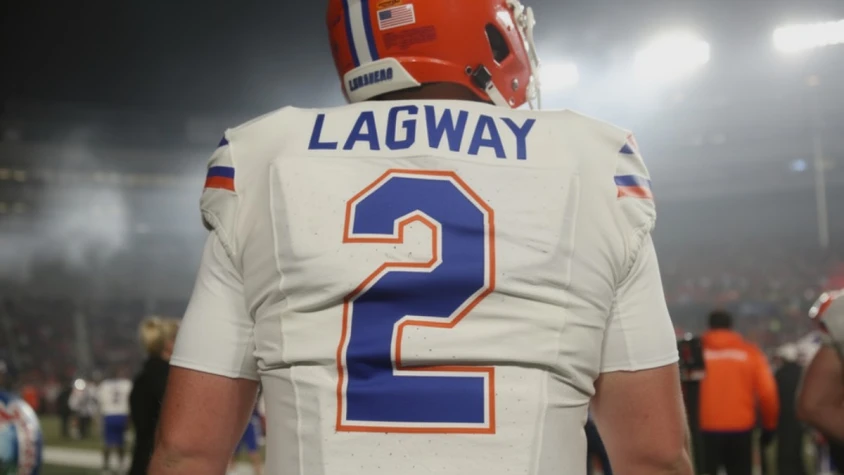
When potential doesn't translate into production
DJ Lagway is entering the transfer portal, ending a two-year stint at Florida that started with promise and ended in disappointment. The former five-star recruit largely committed to the Gators because of Billy Napier, and now that Napier's been fired midway through his fourth season, Lagway is seeking a fresh start. His sophomore campaign was a mess—63% completion rate, 2,264 yards, 16 touchdowns, and 14 interceptions across 12 starts. Those numbers don't scream "former Heisman candidate." They scream "quarterback who regressed and never found his footing."
Lagway flashed legitimate playmaking ability as a true freshman in 2024, stepping in for injured starter Graham Mertz and completing 60% of his passes for 1,915 yards with 12 touchdowns and nine interceptions. That production, combined with his five-star pedigree, positioned him as a potential breakout star heading into 2025. Instead, he struggled with turnovers, inconsistent mechanics, and an offseason that derailed any momentum he'd built. The disconnect between his talent and his performance became the defining storyline of Florida's season.
The offseason that destroyed his development
Lagway underwent surgery for a sports hernia but chose not to repair an injured shoulder. That decision—whether made by his family, trainers, or some combination—meant he didn't throw at all until spring practice ended. Even then, he only threw sporadically until the week before the regular season. Add in a strained left calf during the summer, and Lagway basically missed the most critical offseason for quarterback development: the time between a player's first and second year in college.
This isn't speculation—this is documented fact. Lagway entered 2025 having barely practiced with the team, yet Napier started him Week 1 anyway. He threw for 120 yards and three touchdowns in a blowout win over LIU, which looked dominant on the surface but raised concerns about his limited arm strength and timing. The next week, Florida lost to South Florida, and the struggles only intensified from there. Lagway threw five interceptions in a loss at LSU, three more in a blowout at Kentucky, and posted fewer than 175 yards in six different games. His footwork was sloppy, his mechanics inconsistent, and his decision-making unreliable.
The coaching question nobody wants to answer
How much of this falls on Napier? Starting a quarterback who barely practiced is a decision that reeks of desperation or misplaced confidence. Either Napier believed Lagway's raw talent would compensate for the lack of preparation, or Florida's depth chart was so thin that he had no other viable option. Neither explanation is flattering. If Lagway wasn't ready, why force him into the lineup? If the alternative was worse, why didn't Florida address quarterback depth more aggressively in the transfer portal or recruiting?
Lagway's regression also raises questions about Florida's offensive system and coaching staff. Did they adjust the game plan to account for his limited mobility and inconsistent arm strength? Did they simplify reads and progressions to help him regain confidence? Or did they throw him into the deep end and hope he'd figure it out on his own? The results suggest the latter. Lagway never looked comfortable, never found rhythm, and never developed the consistency that elite quarterbacks need to succeed in the SEC.
The talent versus performance gap
Lagway always said the right things publicly. He understood the responsibility of being Florida's starting quarterback, handled media obligations professionally, and never deflected blame. But words don't win games. His footwork was a mess, his mechanics broke down under pressure, and his decision-making led to costly turnovers in critical moments. Whether that's entirely his fault or a product of circumstances—injuries, poor coaching, depleted receiver room, inconsistent offensive line protection—is impossible to isolate. The reality is that all five factors likely contributed.
But here's the uncomfortable truth: Florida's issues don't excuse Lagway's individual performance. Other quarterbacks face adversity and still produce. Other players deal with injuries and still improve. Lagway had every resource available to him—elite facilities, SEC-level competition, talented teammates—and he regressed. That's not entirely on coaching or circumstances. Some of that falls on the player himself.
Why a fresh start makes sense
Lagway entering the portal is the right decision for both sides. Florida needs to rebuild under a new coaching staff, and continuing with a quarterback who struggled mightily in 2025 doesn't align with that vision. Lagway needs a program that can properly develop him, protect him from rushing back too quickly from injuries, and build an offensive system that maximizes his strengths while minimizing his weaknesses.
The question now is: which program takes a chance on him? Lagway still has elite physical tools—arm strength, mobility when healthy, and the intangibles that made him a five-star recruit. But he's also a turnover-prone quarterback with mechanical issues and a track record of regression. That's a gamble. Some program will bet on his potential, believing they can fix what Florida couldn't. Whether that confidence is justified depends entirely on whether Lagway can stay healthy and commit to refining his fundamentals.
The Gators move on without their former future
Florida bet big on Lagway, and it didn't work out. That's not entirely the program's fault, but it's also not entirely Lagway's fault. Sometimes circumstances align poorly, injuries derail development, and coaching changes disrupt continuity. This was one of those situations. Lagway leaves Gainesville with a 60% completion rate, 4,179 career passing yards, 28 touchdowns, and 23 interceptions. Those numbers don't match the hype that surrounded him when he committed.
But the portal gives him a second chance. Whether he capitalizes on it or repeats the same mistakes will define the rest of his college career. Florida, meanwhile, moves forward with a new coaching staff and the knowledge that banking on potential without proper development infrastructure is a recipe for disappointment. Both sides learned that lesson the hard way.