

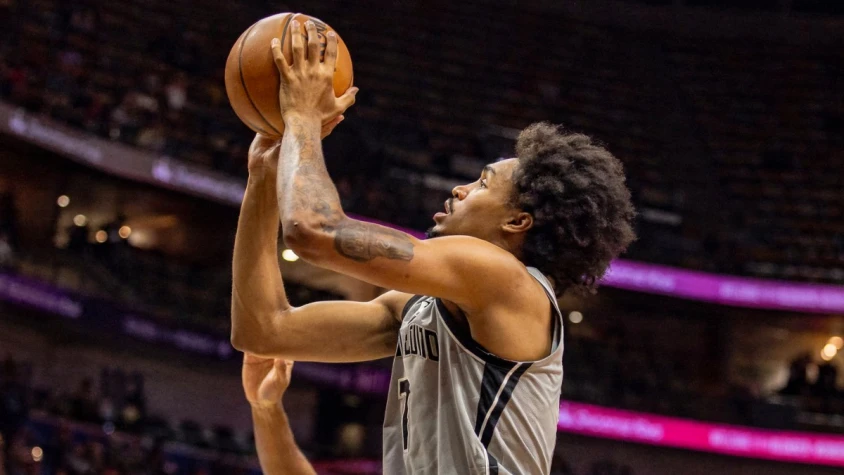
When the game demanded a bucket, the rookie delivered
Nine seconds remaining. New Orleans clawed back from 20 down. The game hanging in the balance. Dylan Harper took the ball, drove physically through contact, and scored the game-winner. San Antonio Spurs 135, New Orleans Pelicans 132. That's not a highlight reel moment—that's a defining play that separates genuine NBA players from prospects still figuring out the league.
Harper finished with a career-high 22 points on 10-of-16 shooting, added 6 assists and 3 rebounds, and most importantly, delivered when his team desperately needed him. The number 2 pick in last year's draft is figuring out how to be a winning basketball player, not just an impressive athlete collecting stats. The distinction matters more than anyone wants to admit.
The performance everyone will ignore because it's not flashy enough
Harper's stat line won't dominate headlines: 22 points, 6 assists, 3 rebounds, 10-of-16 shooting, 1-of-3 from deep, 1-of-2 from the line. That's a very good game, not a transcendent one. But here's what the box score doesn't capture: he made the plays that mattered most when the game was actually being decided. Fourth quarter, team needing buckets to hold off a furious comeback, rookie stepped up repeatedly before sealing it with the game-winner.
Modern basketball analysis has created this perverse incentive structure where we celebrate triple-doubles and 30-point explosions more than we celebrate winning plays in winning time. Harper didn't stuff the stat sheet. He didn't have the flashiest performance on either team—that honor belongs to Derik Queen's absurd 33-10-10 triple-double. But Harper's team won, and he's the reason why in the final moments. That used to be what we valued most in basketball before everything became about highlight reels and fantasy points.
The shooting efficiency is what separates this from empty-calorie scoring: 62.5% from the field. He wasn't jacking up shots hoping volume would save him. He picked his spots, attacked when opportunities appeared, and converted at a rate that indicates genuine offensive competence rather than rookie desperation. The 1-of-3 from three-point range and 1-of-2 from the line aren't ideal, but they're secondary when you're creating offense efficiently inside the arc.
How San Antonio nearly threw away a 20-point lead
The Spurs built a commanding 20-point halftime advantage with Harrison Barnes playing well and De'Aaron Fox assuming his leadership role. Then the third quarter arrived and San Antonio's offense 'collapsed'—apparently forgetting how to score while Derik Queen went nuclear with 21 points on perfect 6-of-6 shooting in just 12 minutes of the quarter. That's not bad luck or officiating—that's a veteran team momentarily forgetting how to close games.
Queen's final stat line is genuinely impressive: 33 points, 10 rebounds, 10 assists on ridiculous efficiency. He single-handedly dragged New Orleans back into a game that should have been decided at halftime. That's the kind of performance that gets highlighted on social media and praised by analysts. Yet his team lost, because individual brilliance doesn't always translate to wins when the other team has someone willing to make the defining play in crunch time.
San Antonio's near-collapse exposes something important about their current construction: they're talented enough to build big leads, but not yet disciplined enough to maintain them without genuine star power available. With Victor Wembanyama out—potentially returning Wednesday against the Lakers—the Spurs are relying on depth and execution rather than individual dominance. That makes Harper's clutch performance even more crucial. They needed someone to steady the ship when Queen threatened to steal the game. Harper did exactly that.
What this reveals about Harper's actual development
The career-high 22 points matters less than how Harper got them and when. He's not a finished product—the 1-of-3 three-point shooting and 1-of-2 free-throw shooting indicate clear areas needing work—but he's developing the most important skill for young players: understanding when to attack and having the confidence to execute in pressure moments. You can't teach that in practice. You learn it by living through tight games and making plays when they matter most.
Harper's 6 assists suggest he's not just hunting his own offense. He's reading the game, finding teammates, operating within San Antonio's system while still capable of taking over when required. That balance is what separates franchise cornerstones from talented scorers who never quite figure out winning basketball. The Spurs have historically developed players who understand this distinction. Harper appears to be following that path rather than chasing empty statistics.
The physical drive for the game-winner is particularly encouraging. He didn't settle for a contested jumper or try something overly complicated. He attacked the rim, absorbed contact, and finished through it. That's old-school basketball competence—the willingness to get hit and still convert when the game demands it. Modern players often shy away from that contact, preferring the safety of three-point attempts. Harper went directly at the defense when it mattered most. That's mentality, not just skill.
The Derik Queen triple-double nobody will remember
Derik Queen put up 33 points, 10 rebounds, and 10 assists. He shot 6-of-6 in the third quarter alone. He nearly single-handedly erased a 20-point deficit. And his team lost, which means this performance will be forgotten by tomorrow while Harper's game-winner gets replayed on loop. That's the harsh reality of NBA evaluation: individual brilliance in losing efforts gets discounted, while clutch plays in wins get immortalized.
Queen's performance was genuinely special—33-10-10 triple-doubles don't happen often, especially from rookies. But here's the uncomfortable truth: basketball is ultimately about winning, and Queen's heroics couldn't overcome Harper's clutch shot-making when the game was actually decided. That's not disrespecting Queen's talent. It's acknowledging that the most impressive stat line doesn't always belong to the most important player in the game's outcome.
This is what drives me mad about modern basketball discourse: we celebrate individual performances divorced from winning context. Queen's triple-double will get social media love. Harper's game-winner will be forgotten outside San Antonio circles. But ask anyone who actually played basketball at high levels which performance they'd prefer, and they'll take the less impressive stats with the clutch bucket every single time. Winning matters more than looking good losing.
What Wembanyama's potential return means for Harper
Victor Wembanyama could return Wednesday against the Lakers, which would dramatically shift San Antonio's offensive hierarchy. Harper won't be asked to carry the load in crunch time with Wemby available. But games like this—where he proves he can deliver without a safety net—are crucial for his long-term development. You can't become a winning player without experiencing pressure moments and succeeding. Harper just got invaluable experience that no amount of practice can replicate.
The Spurs are building something sustainable in San Antonio, not chasing immediate glory. They have Wembanyama as the generational cornerstone. They have Fox providing veteran leadership. They're developing Harper and other young pieces to contribute meaningfully rather than just filling roster spots. That's proper franchise construction—identifying roles, developing players within those roles, and creating an environment where young talent can grow without unrealistic pressure.
Harper's career-high coming with Wembanyama out isn't coincidental—he had more responsibility, more touches, more opportunities to make mistakes and learn from them. When Wemby returns, Harper's role will shrink somewhat. But he'll have proven to himself and his coaches that when called upon, he can deliver in winning time. That confidence matters. It's the foundation for everything else that follows in a career.
San Antonio's quiet winning streak nobody discusses
The Spurs are stringing together victories and positioning themselves as a genuine playoff threat in the West. They're doing it without Wembanyama for stretches, relying on depth, system execution, and young players stepping up when required. This is what actual sustainable success looks like—not flashy superteam construction, but proper player development and smart team-building.
Nobody's talking about San Antonio because they don't fit the narrative. They're not in a major market. They don't have the glamorous star power of Lakers or Warriors. They're just quietly winning basketball games with smart play, good coaching, and players who understand their roles. That used to be what everyone celebrated about the Spurs. Now it barely registers because it's not sexy enough for social media highlight culture.
Harper's game-winner is a microcosm of San Antonio's broader approach: identify talent, develop it properly, put players in positions to succeed, and let them prove they belong through performance rather than hype. It's old-fashioned. It's not trendy. And it still works better than most of the analytics-driven, superteam-chasing nonsense that dominates modern NBA discourse.
The bottom line about what actually matters
Dylan Harper scored a career-high 22 points on excellent efficiency and hit the game-winning shot with nine seconds remaining. Derik Queen had a better stat line and lost. That's the entire story of what separates winning players from talented individuals: making plays when games are decided, not padding stats when outcomes don't matter.
Harper is 19 years old, learning how to be an NBA player, and just delivered in the most pressure-packed moment possible for a rookie. The shooting needs work—1-of-3 from deep and 1-of-2 from the line aren't acceptable long-term. But the mentality, the willingness to attack in crunch time, the physical drive through contact for the game-winner? That's what separates prospects who fulfill potential from those who flame out despite talent.
San Antonio is building another winning culture, one clutch performance at a time. Harper just proved he belongs in it. Everything else is just noise for people who'd rather debate triple-doubles than celebrate winning basketball. The game-winner is the only stat that matters. Harper delivered it. Case closed.