

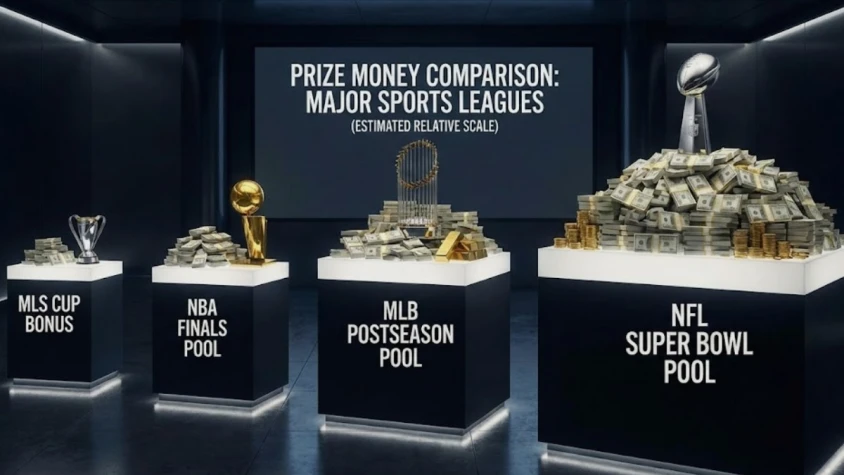
MLS Cup prize money: a reality check
Inter Miami CF just won their first MLS Cup, beating Vancouver Whitecaps 3-1 in a historic final for both franchises. Lionel Messi, Sergio Busquets, and Jordi Alba delivered the title David Beckham's organization has been chasing. The financial reward? $300,000 for the champions.
Three hundred thousand dollars. That's what winning the MLS championship is worth in cold, hard cash. Now let's talk about what champions earn in America's other major leagues, because the comparison is absolutely brutal.
NBA Champions earn 25 times more
The Boston Celtics won the 2024 NBA championship and collected approximately $7.6 million in playoff pool prize money. That's the total distributed to the team, not including individual player bonuses or salary escalators triggered by winning. The pool gets divided among players based on games played and voting shares, but the bottom line is clear: NBA champions earn roughly 25 times what MLS Cup winners pocket.
Even better? The NBA's playoff prize pool totals over $30 million distributed across all postseason participants. MLS? According to Athlons Sports, the entire MLS playoff prize pool sits at approximately one million dollars. The NBA's first-round losers earn more than MLS gives its champions.
NFL Super Bowl winners laugh at $300K
Super Bowl champions don't just get rings and parades—they get paid. Each player on the winning team receives $164,000 for winning the Super Bowl, with additional payments for each playoff round leading up to it. That's per player, not for the entire franchise.
Do the math: an NFL roster has 53 players. If you paid every single player the Super Bowl winner bonus, that's nearly $9 million just in player payments. The losing team's players still get $89,000 each. Meanwhile, Inter Miami's entire organization splits $300,000 for winning MLS Cup.
MLB's World Series pool dwarfs everyone
Major League Baseball operates on a completely different financial planet. The 2024 World Series champion Los Angeles Dodgers received a playoff pool share worth over $30 million to distribute among players and staff. Thirty million dollars. For context, that's 100 times what Inter Miami just earned for winning MLS Cup.
The World Series runner-up receives over $20 million. Teams eliminated in the Championship Series get north of $10 million each. Even Wild Card losers pocket several million. Baseball's financial ecosystem makes MLS prize money look like tip jar collections.
The MLS prize money breakdown
Here's what MLS actually pays, using the same structure as 2024 since the league hasn't published official 2025 figures:
MLS Cup Champions: $300,000Runners-up: $150,000Conference Finals losers: $100,000 eachConference Semifinals losers: $47,500 eachFirst Round losers: $20,000 eachWild Card losers: $0
Vancouver takes home $150,000 for reaching the final. Conference Finals exits earn $100,000. Get bounced in the first round? That's $20,000—barely enough to cover team travel expenses for the postseason.
Why the gap exists
MLS operates under a fundamentally different business model than NBA, NFL, or MLB. Single-entity structure, salary caps, revenue sharing—the league prioritizes parity and controlled growth over winner-take-all economics. Prize money doesn't drive the financial ecosystem the way broadcast rights, sponsorships, and expansion fees do.
The other leagues? They're printing money through massive TV deals, established fanbases, and decades of market dominance. NBA's media rights are worth billions annually. NFL's broadcast contracts dwarf everyone. MLB's regional sports networks generated fortunes before the streaming wars complicated things. MLS is still building toward that level of financial firepower.
The real prize: Champions League qualification
Inter Miami's actual reward isn't the $300,000 check—it's qualification for the 2026 Concacaf Champions League. That's where they face Liga MX giants and other top clubs across North and Central America. That's where Messi gets another continental competition before his career ends.
Champions League exposure brings sponsorship opportunities, international visibility, and legitimacy that cash prizes can't buy. For a club built around Messi's global star power, continental competition amplifies everything—brand value, reach, commercial appeal. That matters more than pocket change.
Context matters, but so does reality
Nobody expects MLS to match NBA, NFL, or MLB prize money overnight. The league is younger, smaller, still carving out market share in a crowded American sports landscape. Growth takes time, and MLS has made legitimate progress over the past two decades.
But let's not pretend the gap isn't embarrassing. Winning the championship in America's top soccer league pays less than being a backup quarterback on a Super Bowl roster. Inter Miami just achieved something historic, and their financial reward wouldn't cover half of Messi's weekly salary. That's the reality of MLS economics in 2025.