

Every January, like clockwork, I get the same text from my uncle in Ohio: "Wait, so the 49ers have to play Seattle even though they beat the Rams during the season?" And every January, I pour myself a drink and prepare to explain the NFL playoff bracket for the hundredth time.
Look, I get it. The NFL's postseason format is genuinely confusing if you didn't grow up breathing this stuff. It's not like the NCAA tournament where you can just follow the lines on a piece of paper. There's reseeding involved. There's a bye that only one team gets. There are division winners with losing records somehow hosting games against wild card teams that won 12 games. It's beautiful chaos, and it's also the reason casual fans stare at the TV screen in January wondering why their team is suddenly flying across the country instead of playing at home.
So let's break this thing down. No corporate jargon. No ESPN graphics. Just the actual nuts and bolts of how the NFL determines its path to the Super Bowl.
The basics: 14 teams, two conferences, zero room for error
First, let's establish the playing field. Since the 2020 season, the NFL has used a 14-team playoff format, with seven teams qualifying from each conference: the AFC and NFC. This expansion from the previous 12-team format happened as part of the league's collective bargaining agreement, and it fundamentally changed how the postseason works.
Here's the breakdown for each conference:
- Seeds 1-4: The four division winners, ranked by their regular season record
- Seeds 5-7: Three wild card teams (the best non-division-winners by record)
That's it. Four division champs get the top four seeds, three wild cards fill out the bottom. Sounds straightforward, right? But here's where it gets interesting—and where the arguments start.
Division winners vs. wild cards: the great inequity that actually makes sense
This is the part that drives people crazy. A division winner is always seeded higher than a wild card team, regardless of record. So when the Carolina Panthers won the NFC South this year with an 8-9 record, they earned the No. 4 seed and a home playoff game. Meanwhile, the San Francisco 49ers finished 12-5 as a wild card and had to hit the road.
Is this fair? Depends on your definition of fair. The NFL's position is simple: win your division and you earn a guaranteed home game. It rewards teams for doing the one thing that's been the currency of NFL football since they split into divisions in 1967—being the best in your neighborhood.
But the wild cards aren't exactly pushovers. Just ask the Philadelphia Eagles, who watched Brock Purdy and the 49ers knock them out of the playoffs this past weekend despite Philly having home-field advantage. Records matter less than people think once January hits. What matters is who's playing their best football right now.
The No. 1 seed advantage: it's not just about rest
Here's the crown jewel of the regular season: the No. 1 seed in each conference. This year, that's the Denver Broncos in the AFC and the Seattle Seahawks in the NFC, both finishing 14-3.
What does being the top seed actually get you?
- A first-round bye: You skip Wild Card Weekend entirely and get an extra week to rest, heal, and game-plan
- Guaranteed home-field advantage: Every playoff game until the Super Bowl is in your stadium
- The easiest path (in theory): You play the lowest remaining seed after the Wild Card Round
That last point is crucial and often overlooked. Sean Payton, the Broncos' head coach, put it bluntly after clinching the AFC's top seed: "When people ask, 'What's the benefit of the No. 1 seed?' Many will say it's the rest. I personally think it's the elimination of a game that you don't have to play."
And he's right. In a single-elimination tournament, not having to play one of those games is massive. One bad quarter, one fluky bounce, one injury—and your season's over. The top seed gets to skip that wheel of fortune entirely in January.
How Wild Card Weekend actually works
Let's talk matchups. During Wild Card Weekend (which the league now brands as "Super Wild Card Weekend" because apparently everything needs a superlative), six games are played—three in each conference. The structure is fixed:
- No. 2 seed hosts No. 7 seed
- No. 3 seed hosts No. 6 seed
- No. 4 seed hosts No. 5 seed
Higher seeds always host. No exceptions. This is why the seeding battles during Week 17 and 18 get so intense. Teams aren't just fighting to get in—they're fighting for the right to play at home, in front of their fans, without having to deal with travel and unfamiliar locker rooms.
This weekend's Wild Card results proved why home field matters but isn't everything:
- Los Angeles Rams (5) defeated Carolina Panthers (4), 34-31
- Chicago Bears (2) defeated Green Bay Packers (7), 31-27
- Buffalo Bills (6) defeated Jacksonville Jaguars (3), 27-24
- San Francisco 49ers (6) defeated Philadelphia Eagles (3), 23-19
- New England Patriots (2) defeated Los Angeles Chargers (7), 16-3
Three road wins out of five completed games. So much for guaranteed home-field success.
The reseeding rule that confuses everyone (but actually rewards excellence)
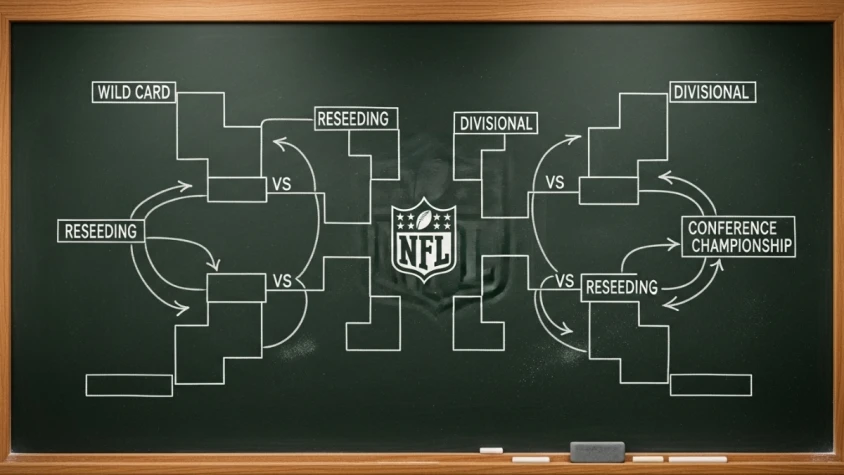
Here's the part that separates the NFL from most other American sports playoffs: the bracket doesn't stay fixed.
After Wild Card Weekend, the remaining teams are reseeded. The No. 1 seed doesn't just play whoever comes out of a specific bracket arm—they play the lowest remaining seed. Period.
Let me illustrate with this year's AFC bracket. The Denver Broncos sat out Wild Card Weekend as the No. 1 seed. After the results came in, here's where things stand:
- Buffalo (6 seed) beat Jacksonville (3 seed)
- New England (2 seed) beat the Chargers (7 seed)
- Pittsburgh vs. Houston happening Monday night (4 seed vs. 5 seed)
Because Buffalo was the lowest remaining seed after beating Jacksonville, they get shipped to Denver for the Divisional Round. The Broncos get the easiest matchup available because they earned it during the regular season. That's the reward for 14 wins.
This is fundamentally different from the NBA playoffs, where the bracket is fixed. In the NBA, if you're the 1-seed and your half of the bracket produces a giant killer, too bad—you're playing them. The NFL says no. You earned the 1-seed, so you play the weakest surviving team. Every round.
Is this controversial? Some fans hate it because it produces "unfair" matchups where a hot team that upset higher seeds keeps getting punished with harder roads. But that's exactly the point. The regular season has to mean something. If you want easier playoff paths, win more games in September through January.
The Divisional Round and Conference Championships: where legends are made
After Wild Card Weekend, eight teams remain—four in each conference. The Divisional Round features four games:
- No. 1 seed vs. lowest remaining seed (hosted by No. 1)
- Highest remaining seed vs. second-lowest remaining seed (higher seed hosts)
The winners advance to the Conference Championship Games. By this point, only four teams are left standing, and the stakes are astronomical. Win, and you're going to the Super Bowl. Lose, and you spend the entire offseason wondering what could have been.
This year's divisional round is setting up to be electric. In the NFC, the Seahawks will host the 49ers after San Francisco's upset of Philadelphia. The Bears will welcome the Rams. In the AFC, Denver hosts Buffalo, and New England awaits the winner of Steelers-Texans.
The Conference Championships are straightforward: highest remaining seed hosts, winner goes to the Super Bowl. If both 1-seeds survive, they host. If not, whoever's left with the better regular season record gets the game at home.
Super Bowl: the one neutral game that ends everything
The Super Bowl is the only playoff game without home-field advantage determined by seeding. The location is selected years in advance—this year's Super Bowl LX will be at Levi's Stadium in Santa Clara, California on February 8. Conference champions meet, AFC vs. NFC, and that's the ballgame.
Home designation alternates by conference each year, which determines which team wears home jerseys and uses the home locker room. It's purely ceremonial at this point—what matters is the Lombardi Trophy.
Why the NFL playoff format is actually brilliant (even when it's frustrating)
Compare the NFL to other American sports:
NBA: 16 teams make the playoffs out of 30 (53.3%). The regular season often feels meaningless until the final stretch. Fixed bracket system means no reseeding.
MLB: The format changes seemingly every other year, but currently 12 teams out of 30 (40%) qualify. Best-of series mean more randomness can be overcome, but also drag the postseason into November.
NHL: 16 teams out of 32 (50%) make the playoffs. Similar fixed-bracket issues as the NBA.
NFL: 14 teams out of 32 (43.75%) qualify. Single-elimination throughout. Reseeding rewards regular season excellence. Every game matters.
The NFL has managed to create a system where Week 18 games are almost always meaningful, where being the top seed provides real advantages beyond just bragging rights, and where the postseason feels like its own mini-season with genuine stakes from the first snap.
Is it perfect? No. The division-winner-always-seeds-higher rule can produce some awkward optics. But the alternative—seeding purely by record—would diminish the importance of division races that fuel rivalries and local intensity throughout the season.
Historical context: how we got here
The current 14-team format is relatively new. The NFL used 12 playoff teams from 1990 to 2019, with the top two seeds in each conference earning byes. The expansion added one wild card team per conference and eliminated one bye, making the top seed even more valuable.
Before 1990, it was 10 teams (1978-1989). Before that, 8 teams (1970-1977). The playoffs started in 1933 with just the two division winners meeting for the championship. The format has expanded basically every time the league has grown or wanted to generate more revenue from postseason games.
But the core principle has remained constant: win your division, and you're in. Be one of the best remaining teams, and you get a wild card spot. Earn the top seed, and you get advantages. It's a meritocracy with guardrails for divisional competition.
The 2025-26 playoffs: a season of firsts
This postseason already has historical significance before a single Divisional Round game has been played. For the first time since 2014, the Kansas City Chiefs aren't in the playoffs. Patrick Mahomes, who hadn't missed the postseason since becoming a starter in 2018, is watching from home.
According to NBC Sports, this is also the first playoff since 2007 without either the Chiefs or the Baltimore Ravens. And perhaps most remarkably, it's the first postseason since 1998 not to feature Peyton Manning, Tom Brady, or Patrick Mahomes. The generational quarterback torch has been passed—at least for this year—to players like Bo Nix, Drake Maye, Caleb Williams, and Josh Allen.
Peyton Manning himself acknowledged the changing of the guard when discussing Nix's emergence in Denver. "The one seed doesn't excite me as much as winning the division," Manning said on ESPN's This Is Football. "The Chiefs have been the bully in that division. Until someone beats the bully, it was their division. That's what excites me."
The Broncos did exactly that, claiming their first AFC West title since 2015—when Manning himself quarterbacked them to Super Bowl 50.
Frequently asked questions (because I'm tired of explaining this at parties)
Why didn't the Seahawks play the Panthers even though Carolina won their division?
Because the bracket is reseeded after each round. The Seahawks, as the No. 1 seed, play the lowest remaining seed after Wild Card Weekend. That ended up being the 49ers (No. 6) after they beat Philadelphia (No. 3). Carolina lost to the Rams and went home.
What exactly is a wild card?
A wild card team is one of the three best teams in each conference that didn't win their division. They qualify based on their regular season record and earn seeds 5, 6, or 7. They don't get home-field advantage in the first round unless they're playing another wild card team in a later round.
Who hosts in the playoffs?
The higher seed always hosts through the Conference Championships. The only exception is the Super Bowl, which is held at a pre-determined neutral site.
Why can a team with a worse record host a team with a better record?
Because division winners (seeds 1-4) are always seeded higher than wild cards (seeds 5-7), regardless of record. Win your division, and you're guaranteed a home game. That's the trade-off for making division races matter.
What happens if two teams have the same record for playoff seeding?
The NFL uses a series of tiebreakers: head-to-head record first, then division record, conference record, strength of victory, and so on down a long list. It rarely goes past the first few tiebreakers.
Final thoughts: embrace the chaos
The NFL playoff bracket isn't designed to be intuitive. It's designed to reward regular season excellence, maintain division relevance, and create the most compelling postseason possible. Sometimes that means watching a 9-8 team host a 12-5 team. Sometimes that means the reigning Super Bowl champions get bounced by a wild card in the first round—just ask Philadelphia.
The beauty of the NFL playoffs is that nothing is guaranteed. One game. One shot. You either advance or you go home. There's no margin for error, no best-of-seven cushion to fall back on.
That's why we keep watching. That's why January football is appointment television. And that's why, despite everything I've just explained, my uncle will probably still text me next year asking why the bracket doesn't make sense.
It makes sense, I promise. It just takes a while to click. And by the time it does, you're hooked—just like the rest of us.