

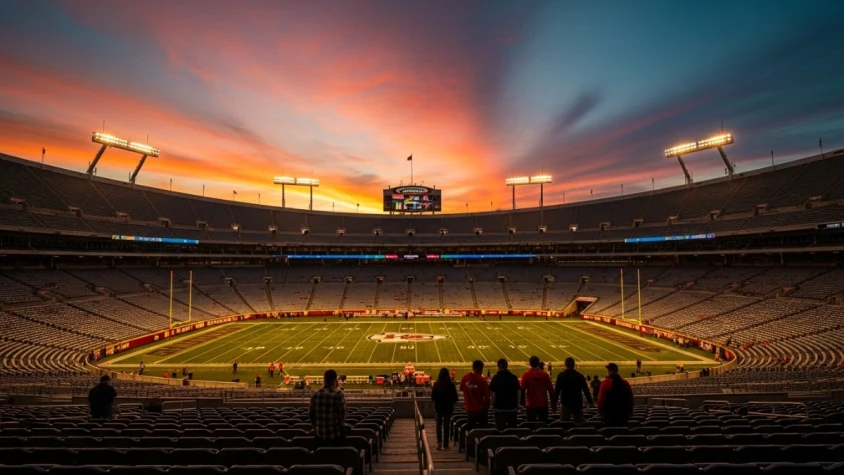
The Kansas City Chiefs are leaving Missouri.
Let that sink in for a moment. One of the NFL's most storied franchises, winners of four Super Bowls, a team that has called Arrowhead Stadium home since 1972, is packing its bags and moving across the state line to Kansas.
The agreement was announced Monday. A $3 billion domed stadium in Wyandotte County. A new headquarters and training facility in Olathe. Opening day set for the 2031 NFL season.
This is the biggest stadium story in pro football since the Raiders moved to Las Vegas. And the implications are enormous.
The Details
Kansas Governor Laura Kelly and Chiefs Chairman Clark Hunt made the announcement in Topeka after lawmakers approved a major tax incentive package.
The total project exceeds $4 billion when you factor in mixed-use development around both sites. The stadium alone will cost $3 billion—a fully enclosed dome with a minimum capacity of 65,000 seats, built to compete with the best venues in the league.
Kansas is covering 60% of the cost through STAR bonds, a financing mechanism that uses future sales tax revenue from the development to pay back investors. The Chiefs are putting up the remaining 40%, approximately $1.6 billion.
The Hunt family is also committing $1 billion in additional development around the stadium and training facility sites.
Why Kansas Won
The short answer? Missouri voters didn't want to pay for stadium renovations.
In April 2024, Jackson County voters rejected a sales tax measure that would have helped finance improvements to Arrowhead. The Chiefs had been exploring options ever since, and Kansas swooped in with an aggressive package that Missouri couldn't—or wouldn't—match.
Kansas officials estimate the project will create over 20,000 jobs during construction and generate $4.4 billion in economic impact. Once built, the stadium is projected to produce over $1 billion in annual economic activity.
Whether those projections prove accurate is another question entirely. Stadium economics are notoriously fuzzy, and taxpayer-funded projects often fail to deliver the promised returns.
But Kansas wasn't thinking about spreadsheets. They were thinking about perception.
"For the rest of the nation, I say take heed," Governor Kelly said. "Kansas is not a flyover state."
What This Means for Arrowhead
Arrowhead Stadium has hosted some of the most legendary moments in NFL history. The noise. The tailgating. The atmosphere that makes opposing teams genuinely uncomfortable.
That's all going away.
The Chiefs will continue playing at Arrowhead through the 2030 season. Six more years of memories. Six more years of playoff games in one of football's most iconic venues.
Then it's over. Arrowhead will likely be demolished or repurposed, and the tradition that made Kansas City's home field advantage legendary will belong to a different stadium in a different state.
"Our fans will still be the loudest in the NFL," Clark Hunt insisted. "Our games will still be the best place in the world to tailgate."
Maybe. But it won't be the same. It can't be.
The Political Fallout
Missouri officials are not happy.
Jackson County Executive Phil LeVota said the county put together "the best plan" for the Chiefs and taxpayers. Jackson County Legislature Chairman DaRon McGee called the relocation "deeply disappointing" and pointed out that "moving a stadium a few miles does not create new regional wealth."
He's not wrong. The Chiefs aren't relocating to a new market. They're staying in the same metropolitan area, the same television market, serving largely the same fan base. The economic benefits Kansas is touting will largely come at Missouri's expense.
This is a zero-sum game dressed up as economic development.
What About the Dome?
For years, Chiefs games have been defined by the elements. Snow games at Arrowhead. Wind swirling through the stadium. Cold that tests the toughest fans.
The new stadium will be enclosed. Climate-controlled. The kind of venue that can host Super Bowls and Final Fours and major concerts year-round.
That's the trade-off. The Chiefs are gaining the ability to host mega-events. They're losing the home-field advantage that comes from playing in brutal conditions.
Whether that matters to a franchise that has won consistently in every type of weather is debatable. But for traditionalists, something is being lost.
The Bigger Picture
The Chiefs' move is the latest example of a troubling trend: billionaire owners using the threat of relocation to extract massive public subsidies.
The Buffalo Bills got $850 million in public money for their new stadium. The Tennessee Titans secured over $1 billion. The Raiders got Las Vegas to fork over $750 million.
Each time, we're told that the economic benefits will outweigh the costs. Each time, independent economists express skepticism. And each time, the deals get bigger.
Kansas just committed $2.4 billion in public financing for the Chiefs. That's money that could have gone to schools, infrastructure, healthcare—things that benefit everyone, not just football fans.
But the NFL gets what the NFL wants. Always.
The Bottom Line
The Kansas City Chiefs will still be the Kansas City Chiefs. They'll still wear red. They'll still have one of the league's best fan bases. They'll still compete for championships.
But Arrowhead Stadium—the place where decades of memories were made—will fade into history. And in its place will rise a shiny new dome, paid for by Kansas taxpayers, serving a franchise that didn't hesitate to leave when a better offer came along.
That's professional sports in 2025. Loyalty is a one-way street.