

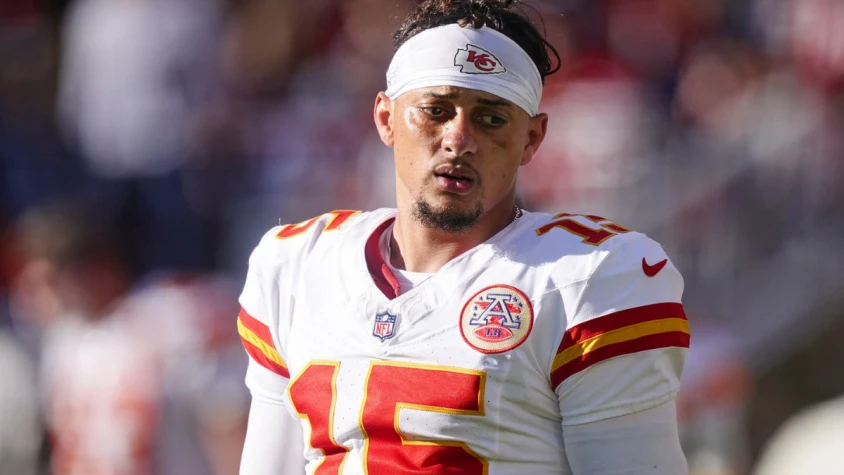
When Rome burns, even the emperor can't stop the flames
Rashee Rice watched the ball sail through his hands on fourth-and-4. With it went Kansas City's playoff hopes, their season, and quite possibly the final gasps of what was once the NFL's most dominant franchise. The Chiefs lost 20-10 to Houston on Sunday night, falling to 6-7 and facing the bitter reality that their championship formula has gone completely stale. Patrick Mahomes threw three interceptions while his receivers combined for six dropped passes—the most in the Mahomes era—and suddenly the dynasty everyone assumed would last a decade looks finished after just a few years.
This isn't bad luck. This isn't a down year before they reload. This is what organizational decline looks like when it arrives all at once: $42.7 million over the salary cap, an aging defense that's slow and unathletic, an offense that can't beat man coverage despite elite talent, and a coaching staff running schemes that have become embarrassingly predictable. General manager Brett Veach faces impossible choices with limited draft capital and cap space. The clock on the Mahomes-Reid era isn't just ticking—it's screaming.
The salary cap nightmare with no easy solutions
Kansas City projects $42.7 million over the cap this offseason. Only Dallas is worse. Veach can release Jawaan Taylor, Drue Tranquill, Kristian Fulton, and Mike Danna to save $40 million. He can restructure Mahomes's $78.2 million cap hit. That might create $30-40 million in space—enough to be a minor free agency player, but nowhere near enough to fix the myriad holes destroying this roster.
The secondary is about to lose cornerback Jaylen Watson and safety Bryan Cook to free agency—both multi-year starters who either need extensions or replacements Kansas City can't afford. In the front seven, only Chris Jones and George Karlaftis are worth building around. Coordinator Steve Spagnuolo—one of the best defensive minds ever—has to blitz relentlessly just to generate pressure while playing veterans like Tranquill and Mike Edwards who are painfully slow. The defense is old, unathletic, and exposed at every level. Fixing it requires resources Kansas City simply doesn't have.
The spring signing of linebacker Nick Bolton to a three-year, $45 million deal perfectly encapsulates Kansas City's problems: paying significant money to a player who's good against the run but awful in coverage in a league that's pass-first. That's not smart roster construction—that's panic spending on familiar names because you can't afford better options. These are the choices facing Veach: overpay mediocre players or field replacement-level talent across multiple positions. Neither wins championships.
Andy Reid's offense has become predictable and stale
The Chiefs rank fourth in yards and ninth in points per game, which sounds respectable until you actually watch them play. Four times this season they've lost while taking 10+ penalties. Travis Kelce dropped a go-ahead touchdown and it became an interception. Mahomes threw a 99-yard pick-six to Jacksonville. They failed to score from first-and-goal at the 1-yard line in Buffalo. The offense disappeared completely against Dallas and Houston. These aren't flukes—they're symptoms of systemic problems nobody wants to acknowledge.
Mahomes had his second game this season completing under 50% of passes—something he'd never done before in his career. His receivers—Rice, Xavier Worthy, Marquise Brown, Travis Kelce—can't beat man coverage consistently and can't catch the ball reliably. Six dropped passes against Houston is catastrophic. Even with an improved offensive line featuring first-round tackle Josh Simmons (currently on IR), the offense goes through lengthy scoring droughts that elite units simply don't experience.
Here's the uncomfortable truth: Matt Nagy's third season as offensive coordinator has been a disaster. Despite having better talent than the 2022 championship team—when they featured JuJu Smith-Schuster, Justin Watson, and Marquez Valdes-Scantling as receivers—the offense has ranked 15th in points per game the past two seasons and is trending that way again. In 2022 with Eric Bieniemy coordinating, Mahomes won MVP throwing for 5,250 yards while the Chiefs scored a league-high 29.2 points per game. Since adding Rice and Worthy, the offense has regressed dramatically. That's coaching failure, not talent deficiency.
Reid's stubbornness is costing Kansas City wins
Andy Reid is a future first-ballot Hall of Fame coach who's forgotten more about football than most coaches will ever know. He's also running an offense that analytics prove should operate primarily under center rather than shotgun, yet he stubbornly refuses to adapt. Repeatedly, the Chiefs have ignored the data to accommodate Reid's preference for running Kareem Hunt and Isiah Pacheco from standstill shotgun formations. The result is an offense with zero explosion despite having the best quarterback on Earth.
Kansas City has managed just two non-Mahomes rushes of 20+ yards all season. That's pathetic for a team that desperately needs a dynamic running game to complement their passing attack. The talent exists—Rice, Kelce, Worthy is a superb receiving trio, and the offensive line is quality. But when your Hall of Fame coach refuses to adapt his scheme to what works, talent alone can't overcome strategic stubbornness.
Nobody's suggesting the Chiefs fire Reid—that would be organizational malpractice. But they absolutely should move on from Matt Nagy and bring in an outside offensive coordinator with fresh ideas rather than recycling former Reid assistants like Mike Kafka or Doug Pederson. The scheme has become stale, predictable, and easily defended by good teams. Reid needs someone willing to challenge his preferences rather than enable them. Otherwise, this decline continues regardless of Mahomes's individual brilliance.
The impossible roster decisions facing Veach
Brett Veach has only six draft picks in 2026 and limited cap flexibility to fix a roster with holes at every level. He must prepare for life without Travis Kelce—whether that's next season or the one after. He needs to decide whether to pay Rashee Rice and All-Pro corner Trent McDuffie, both free agents after 2026. And he should be considering whether trading McDuffie for a pair of top-100 picks makes more sense than paying $30 million annually to a cornerback who vacillates between slot and boundary roles.
After the 2021 AFC Championship loss to Cincinnati, Veach shocked the football world by trading Tyreek Hill for five draft picks. That bold move reset Kansas City's roster construction and bought them flexibility. McDuffie won't command that return, but if the choice is between paying him $30 million or acquiring two quality draft picks, perhaps trading him is the smarter long-term play. These are the brutal calculations facing a GM with no easy options and limited resources to execute them.
The defense needs complete reconstruction. The offense needs scheme innovation and a dynamic running back. The salary cap situation is dire. The draft capital is limited. Veach performed miracles before—finding Mahomes, building Super Bowl rosters with limited resources, making the Hill trade work. But this situation is different. The problems are more numerous, the resources are scarcer, and the margin for error has disappeared completely. One or two smart moves won't fix this. Kansas City needs a multi-year rebuild while somehow keeping Mahomes's championship window open. Good luck threading that needle.
Mahomes can't carry a broken franchise alone
Patrick Mahomes is still the best player in football. Three interceptions against Houston doesn't change that—two resulted from receiver mistakes, and even elite quarterbacks have bad games. But here's what should terrify Chiefs fans: Mahomes is playing at an MVP level and his team is 6-7 because everything around him has deteriorated to the point where individual brilliance can't compensate anymore.
In 2022, with a decidedly worse supporting cast, Mahomes won MVP and a championship because the scheme was fresh, the coaching was adaptive, and the team made fewer catastrophic mistakes. Now, with better talent surrounding him, the Chiefs are missing the playoffs because receivers drop passes, the offensive line commits drive-killing penalties, the defense can't stop anyone, and the coaching has become predictable. That's not Mahomes's fault. That's organizational failure at every other level.
The most disturbing aspect? Mahomes's prime years are being wasted watching this slow-motion collapse. He's 30 years old with perhaps five to seven years remaining at elite level. Kansas City just burned an entire season being 6-7 with limited playoff hope. They'll spend next season trying to patch holes with insufficient resources. That's potentially two years of Mahomes's prime completely wasted. Championship windows don't stay open indefinitely, even for generational talents. The Chiefs are learning that lesson the hardest way possible.
What actually went wrong in Kansas City
The Chiefs' dynasty collapsed because they made every mistake championship teams aren't supposed to make. They got old and slow defensively without replacing aging veterans. They paid mediocre players significant money because of familiarity rather than performance. They allowed their offensive scheme to become stale and predictable. They ignored analytics that contradicted coaching preferences. They assumed Mahomes's greatness would paper over structural deficiencies indefinitely, and now they're discovering that even the best quarterback alive can't win alone.
Six dropped passes against Houston. Three Mahomes interceptions, most on receiver mistakes. A defense that can't stop anyone without blitzing constantly. Ten-plus penalties in four different losses. Goal-line failures. Pick-sixes in crucial moments. This isn't a team experiencing bad luck—this is a team that's fundamentally broken at multiple levels and lacks the resources to fix it quickly. Rome didn't fall in a day, but once it started collapsing, nothing could stop the decline.
Kansas City had nearly a decade of dominance within reach. They had Patrick Mahomes, Andy Reid, and everything aligned for sustained excellence. Instead, they'll be lucky to squeeze out one or two more playoff appearances before this core completely disintegrates. That's not pessimism—that's looking honestly at their cap situation, roster construction, coaching staleness, and organizational trajectory. The dynasty is over. The only question is whether they can salvage anything before Mahomes's prime ends too.
The cold reality nobody wants to face
The Chiefs are 6-7, $42.7 million over the cap, with six draft picks and no easy solutions. Their offense has become predictable despite elite talent. Their defense is old, slow, and unable to stop anyone. Their Hall of Fame coach is running schemes that analytics prove don't work. Their generational quarterback is throwing three interceptions while his receivers drop six passes. This isn't a championship team having a down year—this is a dynasty dying in real-time while everyone pretends one or two moves will fix everything.
Brett Veach faces the impossible task of rebuilding a roster with no money, limited picks, and a coaching staff resistant to necessary changes. He can cut veterans and create cap space, but that doesn't address the fundamental problems: the scheme is stale, the supporting cast can't execute, and the organizational culture has shifted from championship excellence to comfortable mediocrity. Fixing that requires painful decisions—firing coaches, trading stars, accepting short-term pain for long-term benefit. Whether ownership has the stomach for those moves remains unclear.
Patrick Mahomes deserves better than watching his prime years evaporate in 6-7 seasons while his receivers drop passes and his defense allows 20+ points to mediocre offenses. The clock is ticking. The dynasty is over. And unless Kansas City makes radical changes immediately, Mahomes will waste the back half of his career the same way Aaron Rodgers did in Green Bay—individually brilliant on teams not good enough to win championships. That's the cold reality facing the Chiefs. Whether they're honest enough to acknowledge it and act accordingly will determine if they salvage anything from the Mahomes era or watch it end in disappointing mediocrity.