

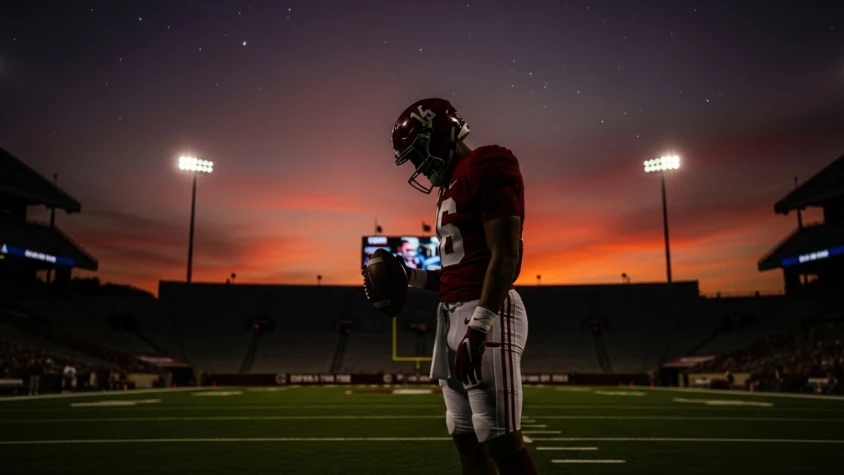
Six and a half million dollars. That's what Miami was willing to pay Ty Simpson to spend one more year in college football. Tennessee offered $5 million. Ole Miss matched Miami's number. And the Alabama quarterback, a guy who sat on the bench for three full seasons before getting his shot, said no to all of it.
When I first saw the numbers, I figured this was either a clerical error or Simpson's agent playing games. Nobody turns down that kind of money for the privilege of getting hit by 280-pound linebackers. But Simpson actually did it, and his explanation is the most interesting thing I've heard from a college athlete in months.
"How many people can say they were going to put their hand in Denny Chimes and foot in Denny Chimes and then go play somewhere else?" Simpson told AL.com on Wednesday. "It wouldn't have felt right to me."
There's something almost quaint about caring where your handprints end up. In a sport where the transfer portal has become a revolving door and NIL deals have turned loyalty into a punchline, Simpson chose to be the exception. Whether that's admirable or financially foolish depends on your perspective. Probably both.
The numbers behind the decision
Simpson's agent Peter Webb fielded the offers while his client tried to figure out what he actually wanted. According to On3's Chris Low, the bidding war escalated fast. Miami started at $4 million, then jumped to $5 million within minutes after losing out on Sam Leavitt to LSU. By Sunday, the Hurricanes had pushed the offer to $6.5 million, which would have made Simpson the highest-paid player in college football history.
"I had a knot in my stomach," Simpson admitted. "I didn't know what to do."
His parents put it in perspective during a family conversation. According to Simpson, they told him that $6 million was more than they'd made in their entire marriage combined. Jason Simpson has been the head coach at UT Martin for 21 years, winning five Ohio Valley Conference titles. That's a successful career by any measure, and his son was being offered more for eight months of work than his dad earned in two decades.
But the thing his parents wanted most, Simpson said, was for him to be happy.
Nick Saban's two sentences
When Simpson needed to clear his head, he called the guy who recruited him to Alabama in the first place. Nick Saban, now working as an analyst for ESPN, has apparently stayed close to his former players. Simpson describes him as having "a way of helping you see things clearly, sort of like your grandfather."
Saban's advice was simple. "Take the money out of it," he told Simpson. "If everybody was offering you zero dollars, what would you want to do? Would you want to come back and play college ball, or would you want to go play NFL ball?"
Simpson's dream since childhood was the NFL. The question answered itself.
The wait that almost broke him
What makes Simpson's loyalty interesting is the context. He signed with Alabama as a five-star recruit in 2022, the No. 2 quarterback in his class. Then he watched Bryce Young win a Heisman Trophy. Then he watched Jalen Milroe take over. Simpson threw 50 passes in his first three seasons combined.
There were moments when leaving made sense. His sister Emma told the Jackson Sun that those years were hard on him. "I could see and hear how much he was hurting," she said. "But that might've been the best thing that could've happened to him."
When Kalen DeBoer arrived from Washington, Simpson finally got his chance. He ran with it. Through nine games, he was completing nearly 70% of his passes with a 21:1 touchdown-to-interception ratio. The Heisman conversation included his name. Alabama beat Georgia in Athens, snapping a 33-game home winning streak. It felt like vindication for all those years of patience.
Then things got complicated. The offense sputtered against better defenses. Alabama limped into the playoff and got demolished by Indiana 38-3 in the Rose Bowl. Simpson left that game with cracked ribs and a lot of questions about his draft stock.
The draft calculus
Here's where the math gets interesting. Simpson is projected as a late first-round pick, somewhere between picks 15-25 depending on whose mock draft you trust. Mel Kiper has him going No. 16 to the Jets. At that slot, his rookie contract would be worth roughly $4 million per year over four years, fully guaranteed.
Miami was offering $6.5 million for one year. On pure dollars, staying in college made more sense. But Simpson's father Jason said his son received first-round grades from every NFL general manager they contacted. "Nobody said second round," he told ESPN's Pete Thamel.
Simpson also pointed out that if he'd transferred, he'd be remembered as "the guy who took all this money and went to Miami or Tennessee for his last year." Instead, he'll be remembered as an Alabama captain who put his imprints in Denny Chimes and chose to honor that commitment.
Whether NFL teams will care about that distinction is debatable. But Simpson clearly does.
What this actually means
I'm not going to pretend Simpson's decision proves that loyalty still exists in college football. It doesn't. The transfer portal is still a circus, NIL is still turning 19-year-olds into millionaires, and next year's top quarterback will probably auction himself off to the highest bidder.
What Simpson's decision proves is that some players still care about things that can't be monetized. He earned two degrees at Alabama. He became a team captain. He built relationships with coaches and teammates across two different staffs. Turning all of that into a one-year rental for a program that only wanted his arm felt wrong to him.
"I would have lost everything that I built at Alabama," Simpson said.
Joel Klatt disagrees with the decision from a purely football standpoint. The Fox Sports analyst has been saying for weeks that Simpson should have stayed in college to build more experience. "Experience pays," Klatt said on his show, "and I'm not talking about dollars and cents."
Klatt has a point. Simpson made only 15 starts. Most successful NFL quarterbacks had at least 30. But Simpson is 23, has a master's degree, and has been waiting for his shot since high school. At some point, you have to stop waiting and take the leap.
Nick Saban, who knows something about developing quarterbacks, apparently thinks Simpson is ready. That's good enough for me.
The 2026 NFL Draft begins April 23 in Pittsburgh. Barring a surprise, Simpson will hear his name called on the first night. When Roger Goodell reads the card, it will say "University of Alabama" next to his name.
That mattered to Ty Simpson. Maybe it shouldn't. But it did.