

When personal tragedy collides with professional obligation
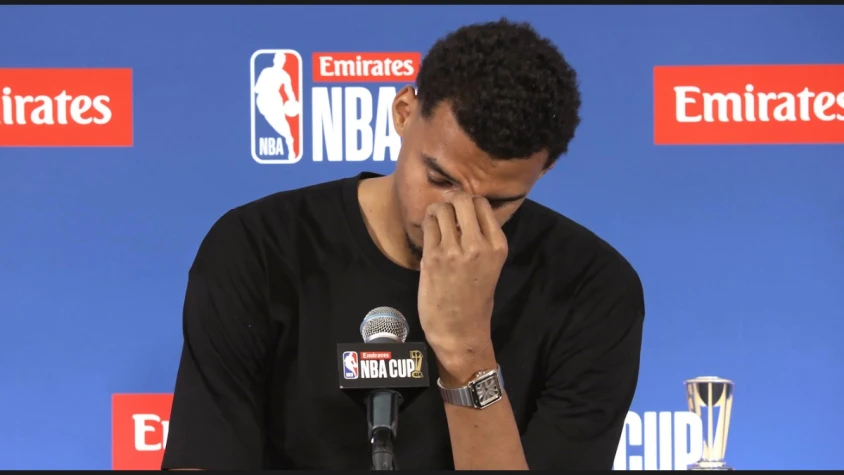
Victor Wembanyama fought back tears during the NBA Cup Final postgame press conference, revealing he'd lost his grandmother shortly before taking the court against the Knicks. The 21-year-old played through that grief in one of the biggest games of his young NBA career, posting 18 points and six rebounds in San Antonio's 124-113 loss. That context reframes everything about his performance—the -18 plus-minus, the struggles finding rhythm, the visible frustration. He wasn't just dealing with returning from injury or adjusting to playoff intensity. He was playing hours after losing someone close to him.
This is the kind of moment that exposes how little we actually know about what athletes are dealing with beyond what happens on the court. Wembanyama's pre-game comments about the Knicks playing "unsophisticated basketball" drew criticism when New York dominated the final. His performance was dissected for missing shots and defensive lapses. None of that analysis included the possibility that he was grieving, because why would it? Players are expected to compartmentalize personal tragedy and perform at elite levels regardless of what's happening in their lives. Wembanyama did exactly that, then broke down when the game ended and the reality hit him fully.
— Hoop Central (@TheHoopCentral) December 17, 2025
The impossible decision nobody should have to make
Wembanyama chose to play. That decision deserves respect, not judgment. Some athletes sit out when dealing with family emergencies or personal loss, and that's completely valid. Others play because competing provides temporary escape from grief, or because they feel obligated to teammates, or because they genuinely believe their loved one would want them on the court. There's no right answer. Wembanyama made the choice that felt right for him in an impossible situation, then delivered 25 minutes of professional basketball while processing emotions that would overwhelm most people.
The Spurs organization clearly supported his decision, whether that meant encouraging him to play or giving him the option to step away. Either way, asking a 21-year-old to make that choice hours before a championship final is brutal. He's still developing as a player, still adjusting to NBA intensity, and still learning how to manage the physical and emotional demands of professional basketball. Adding family tragedy on top of that creates a burden no young athlete should carry alone, yet Wembanyama did it anyway because that's what's expected at this level.
Why mocking him reveals more about the critics
Some people on social media mocked Wembanyama's emotion or used his pre-game comments to justify criticizing his vulnerability. That response is genuinely disturbing. A 21-year-old just lost his grandmother, played through it, then broke down publicly while processing that grief. The instinct to mock that—because he talked trash before the game, because he struggled on the court, because showing emotion is somehow weakness—reflects a complete absence of basic human empathy. Athletes aren't performing monkeys who exist solely for entertainment. They're people dealing with the same losses, grief, and pain as everyone else, except they're expected to do it under public scrutiny while maintaining elite performance.
Wembanyama's pre-game comments about "sophisticated basketball" were competitive talk from a young player confident in his team's chances. They weren't personal attacks or disrespectful slander. The fact that some people are using those comments to justify mocking his grief is grotesque. You can criticize his basketball performance, debate his tactical assessments, or argue about his on-court decisions. But using family tragedy to dunk on someone because they talked trash in a sports context is fundamentally broken behavior that says everything about the critic and nothing about Wembanyama.
The broader conversation about athletes and mental health
This moment highlights why conversations about athlete mental health and personal wellbeing matter. Wembanyama chose to play, but how many athletes feel they don't actually have that choice because sitting out invites criticism about toughness or commitment? How many play through grief, depression, anxiety, or family crises because the alternative is being labeled soft or uncommitted? The expectation that professional athletes compartmentalize everything and perform regardless of circumstances creates a culture where vulnerability is punished and emotional honesty is seen as weakness.
Wembanyama breaking down in the press conference is actually healthy—it's acknowledging reality rather than pretending grief doesn't exist. But the fact that some people responded with mockery shows how far the sports world still needs to progress in treating athletes as complete human beings rather than just performers. Playing through personal tragedy shouldn't be mandatory or expected. If an athlete chooses to compete, that's admirable. If they choose to sit out, that's equally valid. The choice matters more than the outcome, and Wembanyama made the choice that worked for him while clearly struggling with overwhelming emotion.
What this means for how we evaluate his performance
Knowing Wembanyama played hours after losing his grandmother changes how we should assess his performance. The -18 plus-minus and shooting struggles aren't just about rust from injury or the Knicks' defensive scheme—they reflect a player dealing with emotional trauma while trying to compete at the highest level. That doesn't excuse the loss or make his performance immune from analysis, but it provides essential context that was missing from initial evaluations. He wasn't just struggling tactically. He was grieving while playing professional basketball on a national stage.
This doesn't mean every poor performance gets excused with "maybe something's going on personally." But it does mean recognizing that athletes are human beings whose lives don't pause just because they're scheduled to play. Wembanyama could've sat out. He chose to compete, gave 25 minutes, and broke down afterward when the adrenaline faded and reality set in. That's not weakness—it's someone trying to honor their grandmother by playing while knowing she's gone. Criticize his shot selection, analyze his defensive positioning, debate his pre-game comments. But don't mock his grief or use his vulnerability to score cheap points online.
The grace everyone deserves in moments like this
Victor Wembanyama is 21 years old. He just lost his grandmother. He played one of the biggest games of his career hours later, struggled visibly, then broke down in the press conference when asked about it. That sequence deserves compassion, not criticism. It deserves recognition that he tried to compete through unimaginable circumstances, not mockery because he didn't meet performance expectations while grieving. And it deserves acknowledgment that athletes are people first, performers second, even when that reality conflicts with our entertainment demands.
Stay strong, Wemby. Nobody should have to go through what you experienced Tuesday night. The fact that you tried anyway shows character that transcends basketball. And for anyone mocking this situation—grow up. Seriously. Find some basic human decency and recognize that grief doesn't care about trash talk or playoff intensity. It just exists, and dealing with it publicly while the world watches takes more courage than most people will ever need to demonstrate.