

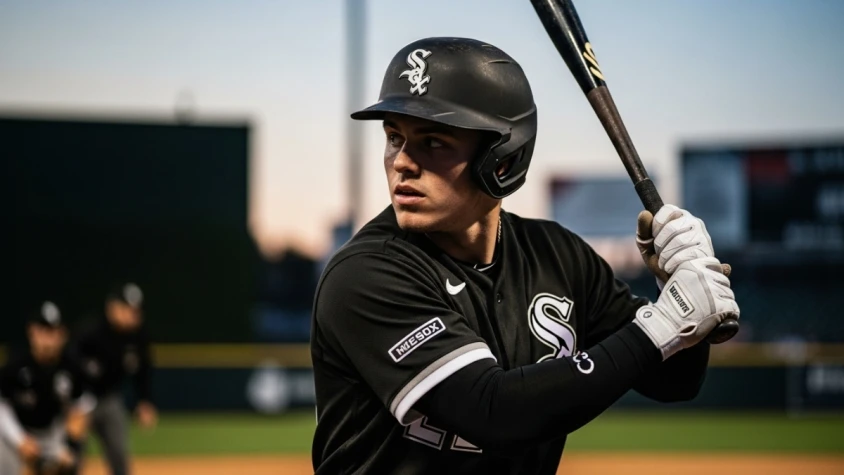
There's something painful about watching a can't-miss prospect become a cautionary tale. And there's something hopeful about watching someone refuse to accept the ending others have written for them.
Jarred Kelenic is 26 years old. That's important to remember. Because when you read the numbers — .211 career average, .658 OPS, 30.6% strikeout rate — it's easy to forget he's still younger than most players when they hit their prime.
On New Year's Eve, ESPN's Jesse Rogers reported that Kelenic signed a minor league deal with the Chicago White Sox, including an invite to spring training. It's the kind of move that barely makes headlines in December. But for those who've followed Kelenic's journey, it feels significant.
The weight of expectations
When the Mets drafted Kelenic sixth overall in 2018 out of Waukesha West High School in Wisconsin, scouts gushed about his left-handed swing, his power to all fields, his ceiling. White Sox fans in particular felt the sting — Chicago had passed on him at No. 4, taking Nick Madrigal instead.
By December 2018, Kelenic was the centerpiece of the blockbuster trade that sent Robinson Canó and Edwin Díaz to Queens. The Mariners had their franchise cornerstone. Or so everyone thought.
His minor league numbers were absurd. At 19, Kelenic reached Double-A and hit .291 with 23 home runs and a .904 OPS. By 2020, he was ranked the No. 11 prospect in all of baseball. By 2021, that ranking had climbed to No. 4.
Then came the majors. And nothing clicked.
Five years of frustration
Kelenic's first taste of the big leagues in 2021 was brutal: a .181 average with 14 home runs in 93 games. The swing-and-miss issues that evaluators had noted in his scouting reports became glaring weaknesses against major league pitching.
His best season came in 2023, when he managed a 111 OPS+ and 1.5 fWAR over 105 games in Seattle. It looked like a breakthrough. Instead, it was an anomaly. The Mariners traded him to Atlanta, and with the Braves, the same patterns emerged: flashes of power undercut by an inability to make consistent contact.
In 2024, Kelenic played a career-high 131 games but posted just an 87 wRC+ with a .286 on-base percentage. Last season was worse — a .167 average in 24 games with Atlanta before being designated for assignment. He spent most of the year in Triple-A Gwinnett, hitting .213 and looking lost.
The Braves let him walk. And now here he is, signing with the team that passed on him seven years ago.
Why Chicago makes sense
The White Sox are rebuilding. That's not a secret. They signed Japanese slugger Munetaka Murakami earlier this offseason and are assembling a roster that's more about upside than proven production. Kelenic fits that mold perfectly.
Right field is unsettled. Luis Robert Jr. remains in trade rumors. Andrew Benintendi has battled injuries. The competition for roster spots includes Everson Pereira and Derek Hill — both right-handed hitters. Kelenic, as a lefty, offers something different off the bench even if he doesn't win a starting job.
"He's still only 26," one front office source told MLB.com's Mark Feinsand when the deal was reported. "There's talent there. It's about whether anyone can unlock it."
The White Sox hitting staff, led by director Ryan Fuller, has made pitch recognition and swing decisions a priority this offseason. Kelenic needs exactly that kind of development focus. He's always had the bat speed. He's never had the plate discipline to use it consistently.
A Midwest kid comes home
There's a poetic element to this signing that goes beyond baseball. Kelenic grew up in Waukesha, Wisconsin — less than 90 miles from Guaranteed Rate Field. He played on the White Sox area-code team as a teenager. The franchise has always been part of his story, even when they chose someone else on draft night.
Now he gets to prove the doubters wrong in front of familiar faces. Or, more likely, he gets one final opportunity to figure out whether the player everyone once believed he'd become ever actually existed.
Minor league deals don't guarantee anything. But they do offer possibility. And at 26, with five frustrating big league seasons behind him, Jarred Kelenic is betting on himself one more time.
Sometimes that's all you can do.