

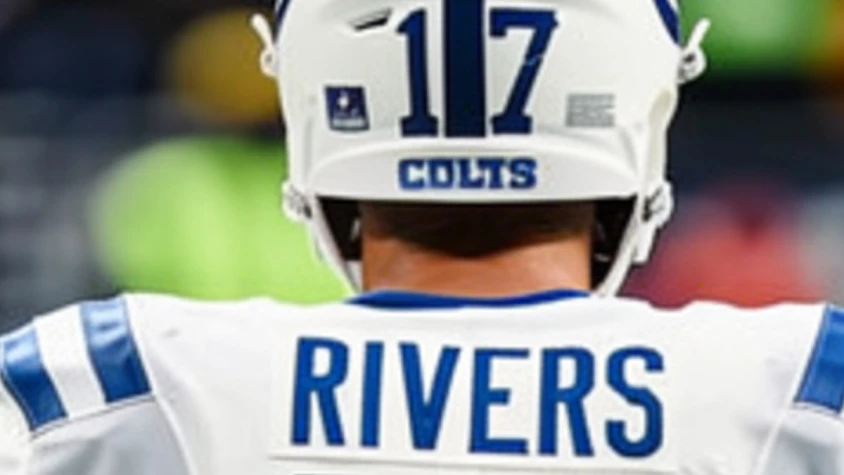
When retirement isn't quite final
Philip Rivers hadn't played professional football in five years. He'd been coaching high school ball, running the Colts' offensive system with teenagers, living a normal post-NFL life. Then Daniel Jones went down with a season-ending injury, Indianapolis needed a quarterback immediately, and Rivers—at 44 years old—walked back onto an NFL field for a start against the Seattle Seahawks. The Colts lost 18-16, with Rivers throwing the game-sealing interception, but the fact that this game happened at all is genuinely absurd.
Rivers finished 18-for-27 for 120 yards, one touchdown, one interception, and a 73.1 passer rating. Those aren't numbers that inspire confidence in a long-term solution, but they're also not catastrophic for someone who last played in 2020 and needed just a couple days of practice to reacquaint himself with NFL speed. The touchdown came late in the first half, showing Rivers still has the timing and anticipation that made him a borderline Hall of Fame candidate. The interception came when the Colts needed him most, reminding everyone why five-year retirements usually stay permanent.
— NFL (@NFL) December 15, 2025
The first half showed flashes of competence
Rivers' touchdown pass before halftime wasn't a deep shot or a spectacular play—it was efficient execution, the kind of quick-release decision-making that defined his career. He read the defense, delivered on time, and put points on the board. For a stretch, it looked like Indianapolis might actually pull this off, that Rivers' familiarity with the system from coaching high school would translate seamlessly to the professional level.
But 120 yards through the air against Seattle's defense isn't moving the needle. That's 4.4 yards per attempt, which ranks somewhere between "struggling backup" and "emergency option who shouldn't be starting." Rivers completed 67% of his passes, which sounds respectable until you realize the limited downfield attempts and conservative game plan designed to minimize risk. The Colts weren't asking Rivers to win the game—they were asking him not to lose it. He couldn't clear even that modest bar.
— NFL (@NFL) December 14, 2025
The ending that everyone saw coming
Rivers' final throw was an interception that ended any chance of a comeback. It wasn't a reckless decision or a terrible read—it was a throw that an NFL quarterback in 2025 makes successfully more often than not. But Rivers isn't an NFL quarterback in 2025. He's a 44-year-old former star trying to replicate muscle memory and timing that eroded over five years away from the league. The interception wasn't shocking. It was inevitable.
This is what happens when you ask someone who last played at 39 to suddenly perform at 44 with minimal preparation. The mind might remember the reads and progressions, but the arm strength isn't the same, the pocket mobility has declined further, and the margin for error shrinks to nothing. Rivers gave Indianapolis a competent performance for three quarters, then reminded everyone why comebacks at this age don't work. Brett Favre couldn't do it. Peyton Manning barely held on at 39. Tom Brady is the outlier, not the standard, and even Brady had the benefit of never actually retiring.
Philip Rivers stats
- 18 of 27 passing
- 120 yards
- One touchdown
- One interception
- One sack taken
- 73.1 QB rating
What this means for the Colts going forward
Indianapolis needed a warm body who understood the offense and could execute basic functions without collapsing entirely. Rivers provided that. But this can't be a sustained solution. The Colts aren't winning meaningful games with a 44-year-old quarterback throwing for 120 yards and barely completing passes beyond ten yards. If Jones' injury keeps him out long-term, Indianapolis needs to either find a younger emergency option or accept that this season is finished.
Rivers deserves credit for even attempting this. Walking away from coaching high school, getting back into NFL shape (relatively speaking), and starting a game with minimal preparation takes genuine commitment. But commitment doesn't translate to arm talent or processing speed at 44. The league has moved on from Rivers' generation of quarterbacks, and Sunday's performance showed exactly why.
The Hall of Fame case this doesn't help
Rivers entered this game as a borderline Hall of Fame candidate—elite regular season numbers, zero Super Bowl appearances, and a reputation for playoff disappointments. This start doesn't drastically hurt his case because voters won't weigh a desperation comeback at 44 heavily. But it also doesn't help. The lasting image is now Rivers throwing a game-sealing interception in a loss, reinforcing the narrative that he couldn't deliver when it mattered most.
His career deserves better than that framing. Rivers was legitimately great for over a decade, consistently productive even when the Chargers' roster construction failed him. But Hall of Fame voters remember endings, and this one wasn't the triumphant return story Indianapolis hoped for. It was a reminder that Father Time remains undefeated, even for gunslingers who once threw for 5,000 yards in a season.
Respect the attempt, acknowledge the reality
Philip Rivers gave the Colts everything he had. He prepared quickly, executed competently for stretches, and competed hard despite being outmatched physically. That's admirable. It's also not enough to justify continued starts if Indianapolis has any playoff aspirations remaining. This was a desperation move that produced exactly what desperation moves usually deliver: short-term functionality with no long-term viability.
The NFL is ruthless about age and decline. Rivers found that out five years ago when he left the league. He got reminded of it again Sunday when his final throw sealed a loss that felt more symbolic than decisive. The comeback was interesting. The results were predictable. And the Colts need to move on before nostalgia costs them more games they can't afford to lose.